

Somebody reported the fire fourteen minutes before it started. Prove it in real SQL. Learn the language from your first line, question a live evidence database, and let the records name the culprit for you.
Somebody reported the fire 14 minutes before it started.
That is one case. There is no dialogue wheel and no lockpicking, you question
the evidence by writing a line of code, and the records answer back.
_____________________________
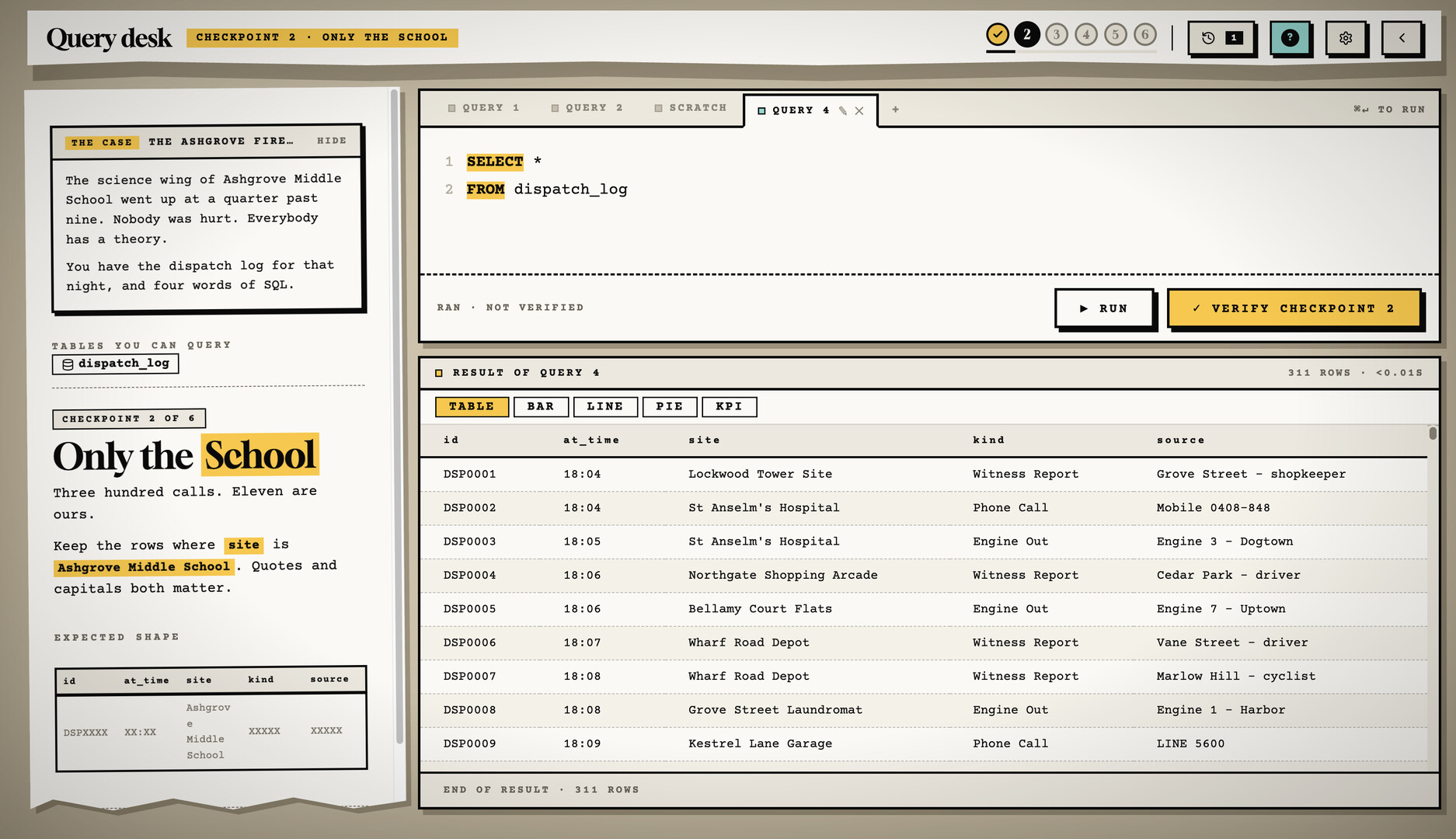
You are writing real code
SQL is the language databases speak, behind every search box, bank statement and
spreadsheet you have ever used. Here it runs for real: your queries hit a genuine
database built from the case's own evidence files, and nothing is scored on
keywords. The rows you produced are compared against the rows the answer
produces.
- Knowledge that leaves the game. The same clauses you would write at
work on Monday. - The database's errors, translated. The game tells you what is actually
wrong with your line, and underlines the word that broke it. - Results you can keep. Read them, chart them, pin them to the wall and
carry on querying.
Start knowing nothing
Every case briefs you before you touch it: a thing that happened becomes a row, a
row has columns, and columns are what you ask for. Then it teaches the language
while you are already solving it — one idea per checkpoint, introduced and used
before the next one is named. A reference card fills in behind you as you earn
each piece.
_____________________________
A casebook that keeps growing
Fires, deaths, missing money, machines that lied. Every case is its own crime and
its own evidence files, and each one leaves you holding a clause you did not have
before. More are on the way.
Printed, not rendered
Newsprint forensics, assembled as a physical collage: torn paper, masking tape,
pushpins, red thread, highlighter and marker redaction, photographed on graph
paper. Nothing on the desk is perfectly straight.
نیازمندیهای سیستم
حداقل
Minimum:
- OS: Windows 10 (64-bit)
- Processor: Dual Core 2,0 GHz (Intel Core i3)
- Memory: 4 GB RAM
- Graphics: Intel HD Graphics 4000 (support WebGL / DirectX 11)
- Storage: 1 GB available space
پیشنهادی
Recommended:
- OS: Windows 10/11 (64-bit)
- Processor: Quad Core 2,5 GHz or more
- Memory: 8 GB RAM
- Graphics: GPU (Intel Iris Xe / AMD Vega 8)
- Storage: 1 GB available space