

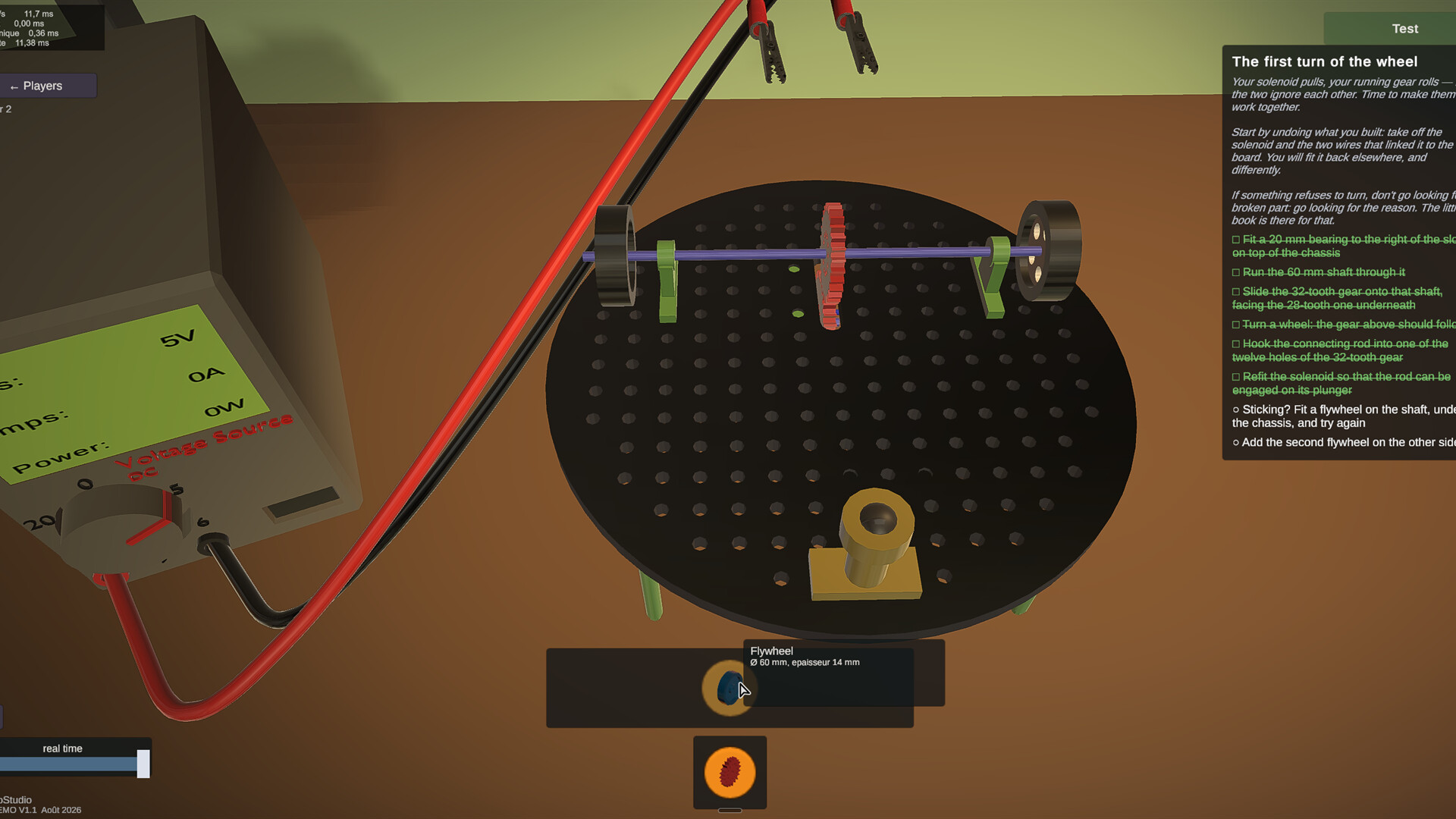
Build a robot from real parts — solenoids, gears, connecting rods — wire it up, and figure out why it won't turn yet. Nothing here is faked: the current is really computed, and every breakdown has a cause you can find.
A perforated chassis, a box of parts, and a robot that has to roll. You bolt the mechanics underneath, you wire the electrics on top, you switch it on — and then you find out what you got wrong.
Build with real parts
Solenoids, gears from 8 to 32 teeth, connecting rods, crank pins, bearings, shafts, drive wheels, flywheels, a contact breaker, capacitors, a resistor, a switch. Every part has a data sheet, real dimensions and a place where it fits. Nothing snaps magically into position: if your two shafts sit a few millimetres too far apart, the gears will not mesh, and the game will tell you by how much.
Nothing is faked
Ten thousand times a second, the game solves a real system of equations to find the voltage at every point of your build and the current in every wire. That is why your machine behaves like a machine. It stalls at dead centre until you fit a flywheel. Your breaker contacts erode spark by spark until they stop conducting — and a capacitor in the right place will save them. The connecting rod tears off if you stretch the linkage too far.
Every failure has a cause, and you can find it
Press F1 and the Encyclopaedia opens: every part, every idea, every fault, cross-referenced. Not a manual — a workshop notebook that explains why the spark eats your contacts, and what a magnetic field has to do with any of it.
In this demo
Five build missions, from a solenoid you slide in and out by hand to a robot that drives itself down a track on its own battery. Then a free sandbox, with the parts box open.
حداقل
- Requires a 64-bit processor and operating system
- OS: Windows 10 64-bit
- Processor: Intel Core i5 (2nd generation) or AMD equivalent
- Memory: 8 GB RAM
- Graphics: NVIDIA GeForce GT 520 / Intel HD Graphics 4000
- DirectX: Version 11
- Storage: 500 MB available space
پیشنهادی
- Requires a 64-bit processor and operating system