

Last Acre
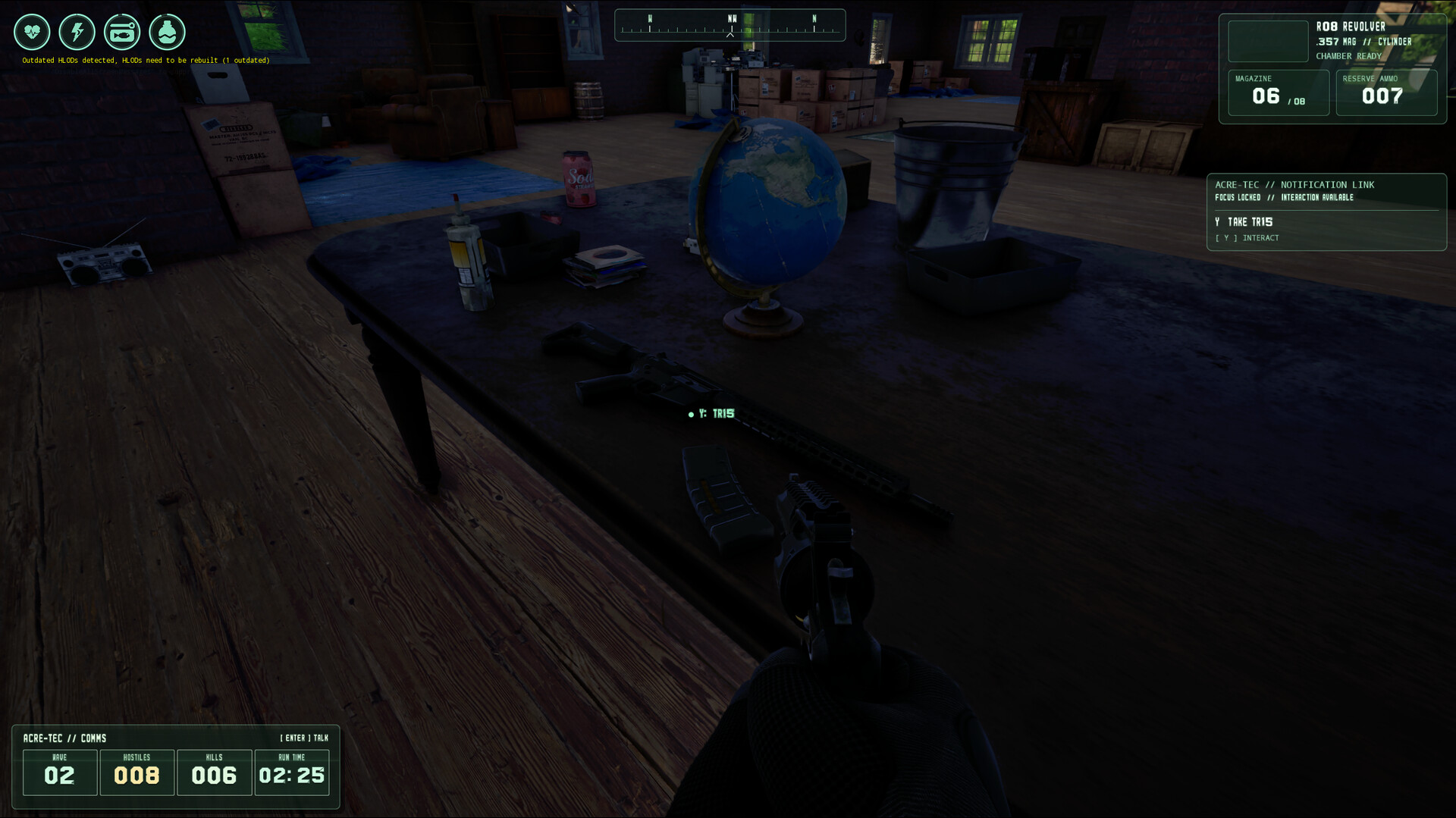
Last Acre is a co-op/single player open-world survival shooter set in post-apocalyptic Michigan. Build and defend your homestead, survive relentless zombie waves, and brave dense forests, abandoned military bases, towns and overgrown roads to scavenge the supplies that keep you alive.
LAST ACRE
Defend your rural homestead against escalating zombie waves in a dark, grounded survival FPS set in Michigan, USA.
Scavenge abandoned homes, farms, towns, and wilderness. Find weapons and ammunition. Grow crops. Cook food. Restore power. Build somewhere worth defending.
The longer you stay alive, the harder the waves become. But in Last Acre, death does not reset the world you built.
SURVIVE THE WAVES. BUILD A WORLD THAT OUTLIVES YOU.
The core of Last Acre is a survival loop built around increasingly dangerous zombie waves.
You begin at Wave 1.
Survive the attack and you are given time to recover, explore, scavenge, build, cook, farm, repair your equipment, and prepare for what comes next.
Then another wave begins.
And another.
Each wave becomes progressively more dangerous the longer you survive.
You might spend that time fortifying the farmhouse you found down the road. Maybe you install a generator, wire up lights, build solar panels and battery storage, plant crops outside, fill the kitchen with food, and cover a wall with the weapons you have collected.
Then, on Wave 18, you die.
Your friends can still save you.
In co-op, another player can revive you and keep the run going.
If nobody reaches you in time, you respawn back at your starting home, your wave progression returns to Wave 1, and the equipment you were carrying is lost.
But your world is still there.
The farmhouse is still fortified.
Your crops are still planted.
The generator is still sitting where you installed it.
The solar panels, batteries, storage containers, furniture, crafting stations, lights, defenses, and weapons you collected are still exactly where you left them.
Death resets your run. It does not reset your world.
If you built your new home several miles away from your original spawn, there is just one problem.
You have to make it back.
Maybe you know the roads now.
Maybe you remember where you left supplies along the way.
Maybe you know which buildings are worth searching and which areas are better avoided.
But you are back at the beginning, poorly equipped, with an increasingly valuable world waiting somewhere out there for you.
Your knowledge survives. Your world survives. You have to earn your way back to it.
The only way to completely return a world to its original state is to deliberately reset it from the main menu.
EVERY CHARACTER HAS THEIR OWN WORLD
Characters in Last Acre are more than cosmetic skins.
Each character has their own persistent world and progression, which you can continue playing for as long as you want or manually reset whenever you want a completely fresh start.
At launch, the playable roster begins with:
Seo Park
Natasha
Mason
Walker
Tactical Operator
More characters are planned over time.
This means you can build completely different lives with different characters.
Seo's world might contain a heavily fortified farmhouse surrounded by crops and solar panels.
Mason's world might revolve around an old industrial building filled with generators, equipment, and scavenged machinery.
Another character might still be surviving out of the original starting property.
Every world becomes a record of how you chose to survive.
LEARN THE LAND
The world of Last Acre is carefully built by hand, but what you find inside it is unpredictable.
Weapons, ammunition, food, tools, equipment, and usable objects are distributed among authored spawn locations when the world populates.
Learning that an abandoned farmhouse might contain a rifle, that a garage can spawn a generator, or that a particular campsite may contain valuable survival equipment becomes knowledge you can carry into future runs.
But knowledge is never a guarantee.
That rifle may not be there next time.
The medicine you desperately need may be somewhere else.
And every additional building you search means spending more ammunition, food, daylight, and time away from safety.
Do you search one more house, or turn back while you still can?
The farther you venture from home, the more dangerous the world becomes.
DARKNESS ACTUALLY MATTERS
Night in Last Acre is genuinely dark.
A working flashlight and a supply of batteries can mean the difference between finding your way home and becoming stranded miles away from safety.
Fires, generators, portable lights, batteries, fuel, solar power, and other sources of electricity are not simply decoration. They are tools that fundamentally change how you survive after sunset.
A powered farmhouse feels very different from one sitting completely dark in the middle of the woods.
And when the lights go out, you are going to notice.
DEFEND WHAT YOU BUILD
Your home is your anchor in the world.
Build it. Expand it. Reinforce it. Stockpile supplies and prepare for what is coming.
Zombie attacks become increasingly dangerous as the waves climb, eventually testing every weakness in your defenses and every decision you made while preparing for them.
The further you go from your starting location, the harder the game pushes back at you. It actively trys to keep you at home, its up to you to endure and try to make it out as far as you can go.
BUILD YOUR HOMESTEAD
Last Acre is designed around extensive and flexible base building.
Construct the home and defenses that make sense for the way you play.
Build walls and fortifications. Place furniture. Install lights. Set up storage. Restore electricity. Run generators. Install solar power and battery storage. Create workshops, kitchens, farms, and equipment areas. If it makes sense to add, we will add it in.
The long-term goal is for players to eventually be able to build and place many of the same kinds of objects they encounter throughout the game world.
You are not simply building a temporary base for one run.
You are changing a persistent world that remains between deaths.
HUNDREDS OF CRAFTABLE ITEMS
Crafting is a major part of Last Acre, with hundreds of usable and placeable items already planned or implemented and a long-term goal of expanding that number into the thousands.
Craft tools, survival equipment, furniture, building components, utilities, supplies, and other objects that allow you to gradually turn a vulnerable property into a functioning home.
Scavenging gives you the pieces.
What you build with them is up to you.
COOKING IS MORE THAN PRESSING A BUTTON
Different cooking surfaces have their own interfaces, requirements, and fuel sources.
Cooking over a campfire should not feel the same as preparing food on a functioning kitchen stove.
Restore power to appliances, gather fuel, prepare ingredients, and make use of whatever equipment you can get working.
Food is a resource, but the way you prepare it is part of survival too.
FARM MORE THAN 40 CROPS
Grow more than 40 different crops using a detailed farming system.
Some plants can survive outdoors in Michigan's climate. Others require the protection of a greenhouse.
Seeds can be discovered while scavenging, while other crops can be harvested directly from fields and locations throughout the world.
Plants have their own requirements, and disease can threaten a crop if it is not properly maintained.
A successful farm can eventually become one of the most valuable things you have built.
And if you die?
It is still there when you come back.
EXPLORE A MASSIVE HANDCRAFTED WORLD
Last Acre takes place across a large, handcrafted open world inspired by rural Michigan.
Forests swallow forgotten roads.
Small towns sit abandoned.
Farms, homes, businesses, industrial sites, national guard outposts, wilderness, and hidden locations reward exploration.
Traveling farther from your starting home also means increasing danger.
Learning shortcuts, landmarks, valuable scavenging locations, water sources, safe areas, and dangerous territory becomes part of mastering the world.
When death can send you all the way back home, knowing the land matters.
Getting there is only half the journey. You still have to make it back.
PLAY SOLO OR WITH FRIENDS
Last Acre is being designed so that owning the game means being able to play it independently.
Play alone or survive alongside friends.
In co-op, other survivors become extremely valuable when things go wrong. A friend reaching you in time and reviving you could mean the difference between continuing a high-wave run and waking up back at home on Wave 1.
Single-player and local-network cooperative play are fundamental parts of the game's design.
Online services can come and go.
Games should not have to disappear with them.
The goal is to ensure that the core Last Acre experience remains playable without depending entirely on a permanent centralized online service.
UNCOVER WHAT HAPPENED
There is a story behind the world of Last Acre, but it is not delivered through a constant stream of exposition.
Explore.
Listen.
Read what people left behind.
Discover abandoned homes and learn about the families who once lived there.
Find places you were never expected to find.
Piece together what happened as the world fell apart.
Some answers will be easy to find.
Others may change how you understand the world entirely.
HOW LAST ACRE USES AI
AI is one of the tools used during the development of Last Acre, but it is not a replacement for artists or handcrafted game development.
I believe there are areas where AI can be extremely useful and others where the work of skilled human artists remains irreplaceable.
Assets such as weapons, buildings, environment assets, characters, clothing, animations, and other major visual content are sourced from or created by human artists. I purchase and license work from artists and asset creators for these parts of the game.
AI-assisted tools are primarily used behind the scenes for things such as:
Assisting with programming and development of complex gameplay systems
Finding bugs and helping diagnose technical problems
Generating certain UI thumbnails from existing in-game meshes
Helping create fictional radio programming and stations
Assisting with fictional characters, families, and environmental storytelling connected to locations throughout the world
The goal is to use modern development tools where they make sense while continuing to support the artists whose work gives Last Acre its visual identity.
Build a home in a world that wants it gone.
Survive as long as you can. Lose the run. Keep the world. Find your way home.