
Subroutine: Deep Space
وضعیت
بهزودیقیمت هنوز در استیم اعلام نشده
A sci-fi programming puzzle game. Repair corrupted ship cores by wiring executable node graphs — memory, logic, and I/O — then step through playback like a debugger until every validation stream passes.
In 3022, Andrew Mercer answered the first SOS from beyond Earth — undeniable proof of other life, asking for help. His wife, Evelyn, told him it was too convenient. A species that had never reached out before does not suddenly need saving. He went anyway.
The exploration ship Maximo never came home.
Their last transmission was another distress call. Then silence. Now a salvage operator is patched into the wreck: dead cores, fractured telemetry, and personal logs from a crew that started noticing the signal changing as they closed in. The pilot’s jokes stopped reaching her eyes. The comms officer saw a frequency no one else would admit was there. Forty-eight hours from history, it already felt like they were going the wrong way.
Recover what they left behind. Find out who called — and why anyone answered.
A visual programming puzzle game
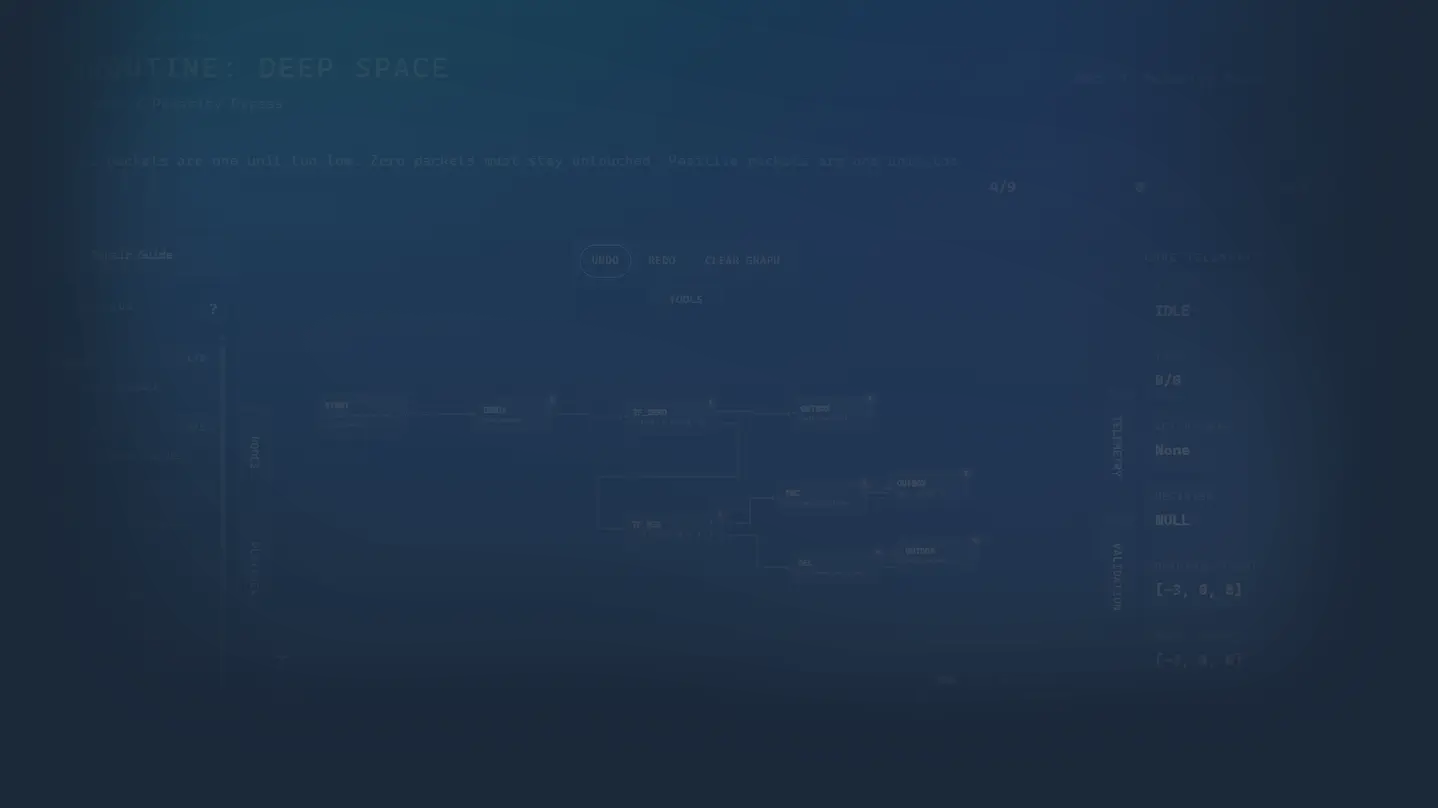
Subroutine: Deep Space is a single-player sci-fi programming puzzle. You repair those dead cores by building executable node graphs. Every deck starts at a protected START node. From the toolbox you place and wire INBOX and OUTBOX for the packet stream, memory slots to hold values, arithmetic and branches for control flow, string ops for headers and tokens, logic gates for boolean work, and clock nodes when a deck cares about timing.
Then you run it. Open the validation panel and press Validate Core. Visible examples show the intended transform; hidden streams still have to pass. If the graph crashes, drops a packet, or exceeds the cycle cap, the core stays dark.
When a solution almost works, use playback like a debugger: step forward and back through ticks, watch the register and memory, and see which node fired. Each deck has a briefing, a repair guide, and a node budget. START, INBOX, and OUTBOX are free; everything else counts. Inefficient graphs fail even if the idea is right.
The goal of every deck is the same: emit the correct output stream. The challenge is how little hardware you spend doing it. Passing unlocks the next deck and can recover another personal log. Ratings (B, A, and S) score your best node count and cycle count against par, so you can return to a solved core and tighten the graph. New instruction types unlock as you move through the wreck, so later decks are not just harder puzzles — they are new kinds of programs.
Early Access
Early Access follows the first ten recovered decks of that expedition aboard the salvage site SV Asterion. A typical first playthrough is a few hours, longer if you chase S-rank solutions. More of the story is planned. Progress is saved locally on this PC. There are no extra game modes in this build — campaign, replay, and optimization are the whole loop.
Decks currently in the build:
Deck 1: Reverse Transmission — store packets and emit them last-in, first-out
Deck 2: Signal Boost — loop the stream and increment every reading
Deck 3: Calibration Offset — save the first packet, add it to the rest
Deck 4: Polarity Normalizer — branch on sign and zero
Deck 5: Parity Ping — reduce each value until you can report odd or even
Deck 6: Repeater Relay — echo every packet twice
Deck 7: Window Slice — cut a fixed routing window out of string headers
Deck 8: Parity Latch — compare boolean pairs
Deck 9: Clock Divider — align wait cycles with the execution clock
Deck 10: Authenticated Length — gate name lengths behind an OPEN token
What you get with this purchase
A 10-puzzle single-player campaign with sequential unlocks and level select for recovered decks
A visual graph editor with undo/redo, node limits, and full keyboard play (rebindable in Settings)
Playback debugger and validation against visible plus hidden test streams
S / A / B ratings for compact, fast solutions
Briefings, repair guides, and an in-game Node Index for every instruction
Recovered story logs from the Maximo expedition
Sci-fi salvage interface with procedural ship-ambient audio
Local saves on this PC (Steam Cloud is planned, not in this build)
Windows 10/11. English.
The exploration ship Maximo never came home.
Their last transmission was another distress call. Then silence. Now a salvage operator is patched into the wreck: dead cores, fractured telemetry, and personal logs from a crew that started noticing the signal changing as they closed in. The pilot’s jokes stopped reaching her eyes. The comms officer saw a frequency no one else would admit was there. Forty-eight hours from history, it already felt like they were going the wrong way.
Recover what they left behind. Find out who called — and why anyone answered.
Early Access follows the first ten recovered decks of that expedition. More of the story is planned. Progress is saved locally on this PC.
حداقل
- OS: Windows 10
- Processor: Dual-core 2.0 GHz
- Memory: 4 GB RAM
- Graphics: DirectX 11 compatible
- DirectX: Version 11
- Storage: 200 MB available space
- Additional Notes: Microsoft Edge WebView2 Runtime (already on most Windows 10/11 PCs). Display at least 1280×800.
پیشنهادی
- OS: Windows 11 64-bit
- Processor: Quad-core 2.5 GHz
- Memory: 8 GB RAM
- Graphics: DirectX 11 compatible
- DirectX: Version 11
- Storage: 200 MB available space
- Additional Notes: WebView2 Runtime. 1920×1080 for the default layout.