
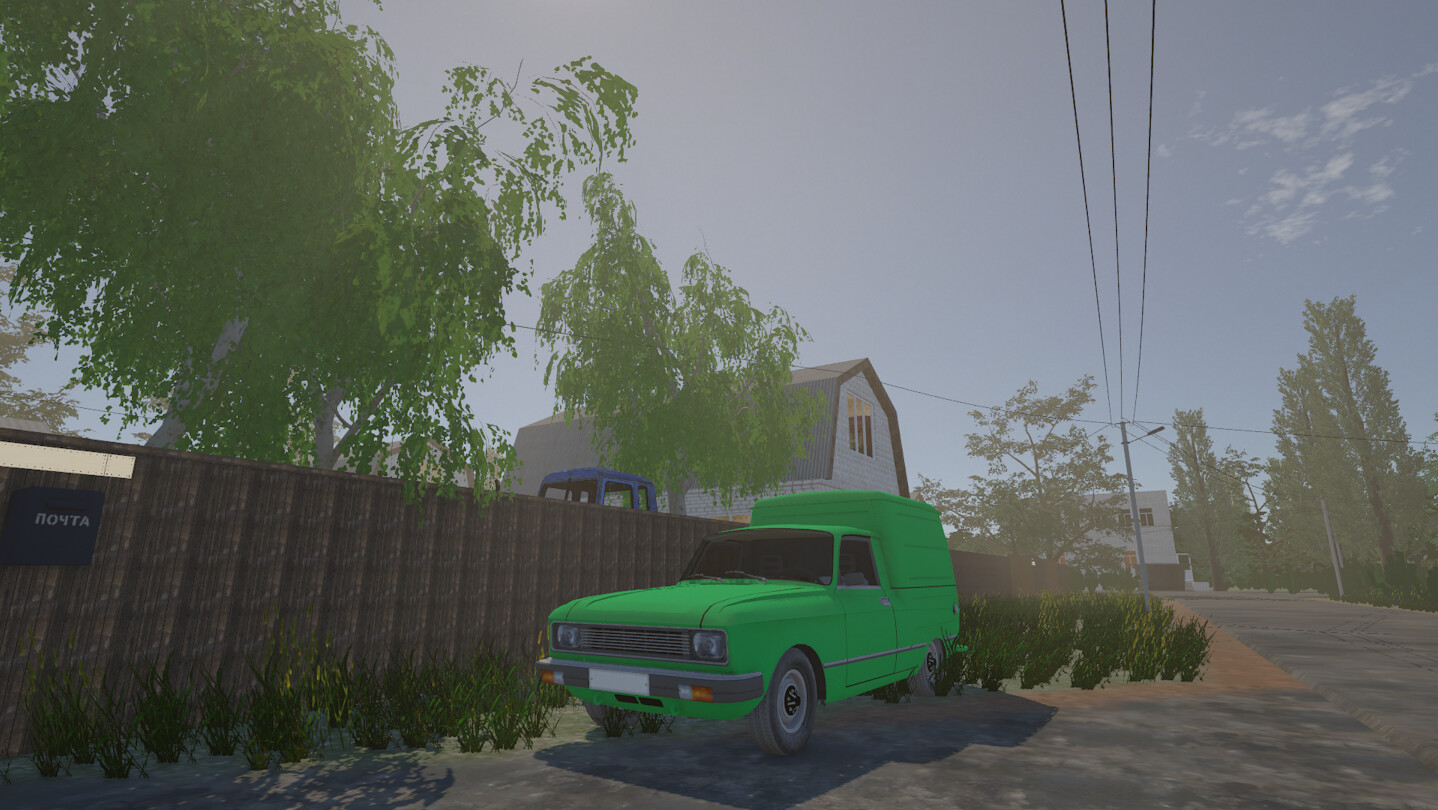
A very simple game with simulation elements. You’ll interact with the world around you, gather collectibles, and—most importantly—easily deliver packages! Who knows what else is hidden in this world...
Tired of the city hustle and bustle, you decided to move to the countryside, where you bought a house and a vehicle; now you can calmly work as a courier for the local post office, delivering packages and collecting items to furnish your home, all while enjoying the warm atmosphere of a small village.
Controls and Gameplay
The controls are fairly standard for this genre but feature some unique touches:
WASD – character movement and driving;
LShift – sprint;
Space – jump;
Z – camera zoom;
G – car ignition;
F – flashlight;
Left-click – interact with an object;
Hold Left-click – manipulate an object;
There are no hotkeys for secondary actions (aside from zoom, flashlight, and ignition); this design choice is intended to enhance immersion. Instead of hotkeys, the game relies on direct interaction with objects. For instance, the car features switches for headlights, windshield wipers, turn signals, and so on. Inside the house, there are separate light switches for each room, as well as for the garage and basement. Even the car seat acts as a type of switch.
A significant portion of the gameplay revolves around interacting with the environment. The game features two types of interaction: toggling and manipulation.
To toggle an object's state, simply hover your cursor over it and left-click. This is how most switches and toggles work. For example, you can turn on the lights, sit on the sofa, go to sleep, change TV channels, and more. There is a wide variety of such interactive elements in the game.
To manipulate an object, hover your cursor over it, hold down the left-click button, and move the mouse in the direction of the object's movement. This allows you to open and close doors and gates, turn knobs, and so forth.
It might seem complex at first, but in practice, it is quite easy to get used to...
The Job
Working as a courier is very simple! You need to go to the post office, enter the manager's office, and select the desired number of packages on the form. Keep in mind, however, that you cannot accept a new order until you have delivered all your current packages; therefore, it is recommended to calculate beforehand how many you can transport. Players typically handle 20 packages without issue—which is the default amount—but you can choose to take just one or load your vehicle to capacity; the choice is yours. Once you confirm the quantity, the packages will appear in the warehouse. You then need to load them into your vehicle, and there are several ways to do this. For instance, you can drive your vehicle directly into the warehouse and load it manually, sorting the packages by street to make delivery easier. There is also a warehouse worker available who will load the packages for a small fee, though this process takes some time. After loading, you can begin making deliveries. To find out where a package needs to go, check the label for the delivery address. When you pick up a package, a marker leading directly to the recipient's mailbox will appear on your map. Simply place the package in the mailbox, and the delivery is complete. Repeat this process for all your packages.
Environment and Features
Map. You find yourself in a small yet highly varied village. You can open any gate and enter any yard; some yards even have a secondary exit located behind the vegetable garden. In addition to the yards, the map features a market, a forest clearing, a cemetery, and a lake. Every location serves a specific function and purpose, offering unique gameplay elements.
Vehicles. You have a choice of two vehicles: the 27175 and the 2715SL, each with its own distinct characteristics.
The 27175 is a standard compact cargo van built using the 2104 platform. It offers extensive customization options and high cargo capacity thanks to its long wheelbase.
The 2715SL is a non-production variant of the original van (based on the Moskvich 412) that incorporates body panels and interior components from the 2140SL model. It has a short wheelbase, resulting in lower cargo capacity but superior handling; while customization options are limited, it boasts a greater number of detailed, unique features.
Fuel System. It’s straightforward: the vehicle consumes gasoline. Higher-performance engines consume more fuel, so it is advisable to turn off the engine if you plan to step away from the vehicle for an extended period. The game offers two types of gasoline: 92 (cheaper) and 95 (more expensive). Engine performance varies depending on the fuel used: cheaper fuel results in slower starting and sluggish throttle response, whereas premium fuel ensures much better performance. However, you can also save money by mixing fuels—filling half the tank with premium and half with regular—resulting in a blended fuel quality. This allows for experimentation.
Customization. The game features several tuning options, though their availability depends on the specific vehicle. In its stock configuration, the car is adequate for basic road driving but lacks off-road capability; you will need to purchase appropriate tires and an engine upgrade. In addition to functional upgrades, visual customization is also available.
Radio. The game includes a radio station that can be heard via the car's radio or a standalone receiver (if purchased at the market). However, the station isn't currently broadcasting, so the radio emits only static.
Television. You can switch between eight channels on the TV and adjust settings like volume, brightness, and image parameters. However, the television system isn't fully implemented yet; there are no actual channels, and the screen displays only static.
Tape Player. In addition to the radio, you can listen to your own music; simply buy a tape player at the market and place your music files in the game's "Music" folder. A key feature of the tape player is its portability—you can take it with you wherever you go.
Pedalo. There is a water access point in the recreation area at the northern end of the village, where a pedalo is moored at the dock. You can take it out on the water.
Secret Hatch. A secret hatch is hidden somewhere on the map. No one knows why it is there or what lies beneath it; the answer remains a mystery.
Collectibles. The house contains various pieces of furniture—wardrobes, nightstands, and shelves—but they are all empty. You must find collectibles to fill your home and make it feel cozy. However, the total number of collectibles cannot be specified yet, as this mechanic has not been implemented.
Troubleshooting. Creating a flawless gameplay experience in projects of this type is challenging; even professional teams sometimes struggle with this, requiring time and dozens of updates to resolve issues. This game is no exception; it can still encounter issues. That is why the pause menu includes a "Troubleshooting" tab, which features reset buttons for various situations.
حداقل
- Requires a 64-bit processor and operating system
- OS: 10
- Memory: 4096 MB RAM
- DirectX: Version 11
- Storage: 5 GB available space
پیشنهادی
- Requires a 64-bit processor and operating system
- OS: 10
- Memory: 4096 MB RAM
- DirectX: Version 12
- Storage: 5 GB available space