
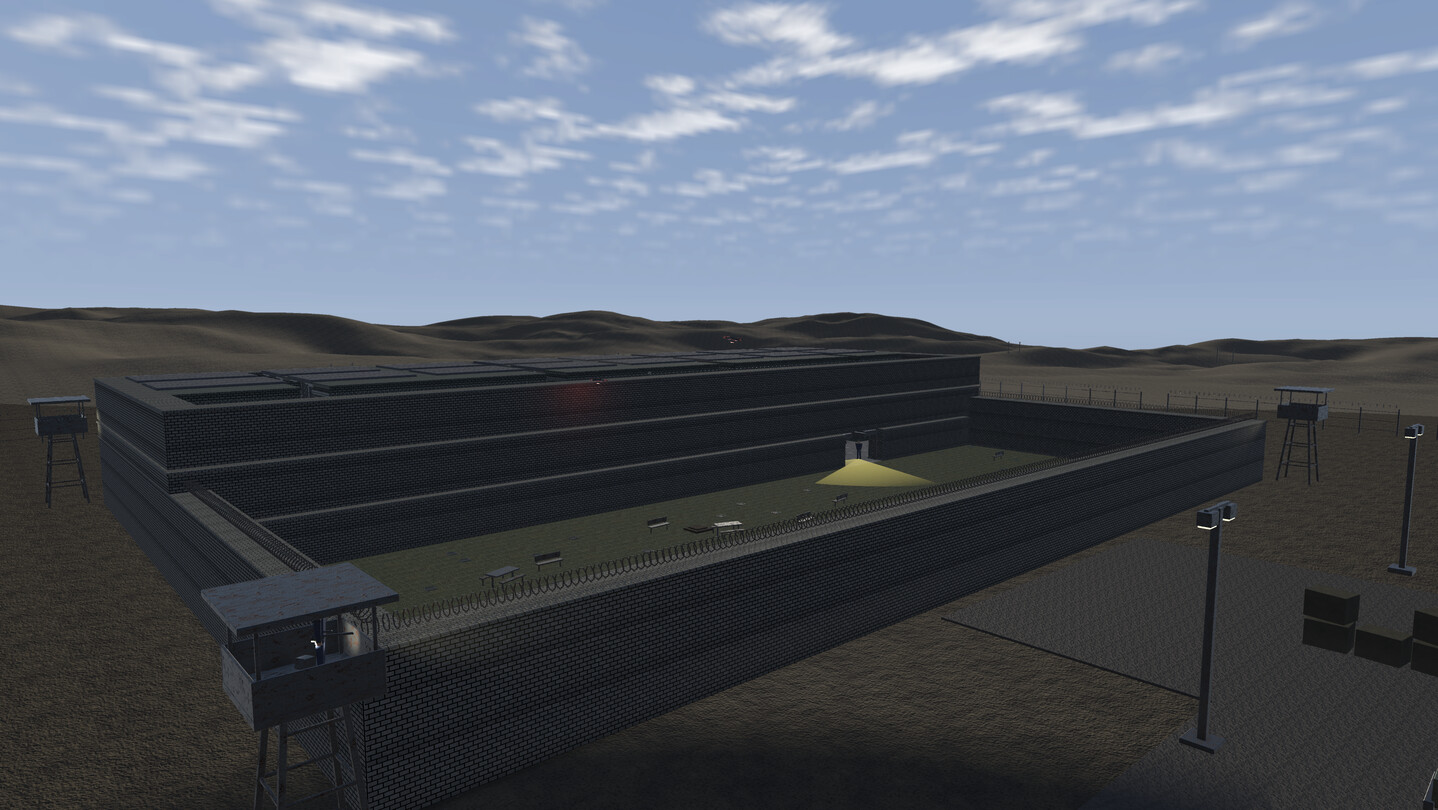
Prison Break: Thirty Walls
Being seen somewhere you shouldn't be is the beginning of the problem. Thirty procedurally built prisons, each with one way out. Learn the routine, find the shovel, dig — and when the shovel isn't enough, find another way through the wall.
Learn the day. Then break it
The prison runs on a clock, and the clock decides what counts as suspicious. In the yard at yard time you are furniture. In the yard at lockdown you are the alarm. Every guard, camera, searchlight and drone asks the same question, and the answer changes four times a day.
Find the shovel. Get it back to your cell. Dig. By level twelve the shovel is behind a locked door and the key is on a guard; by eighteen the guard has a club. Every prison you beat makes the next one a link longer. Get caught and you wake in solitary at the far end of the building, with the walk back to think about it.
Thirty prisons, none drawn by hand
Every prison is generated from a plan and a seed. Play the same seed twice and you get the same building. Move to the next one and you'll never see it again. Towers, yards, cell blocks, fences and floodlights are laid out fresh every time, so what worked last prison only half works in this one.
Trouble is also an opening
Yard fights pull every guard who can see them, and the routes they were covering go uncovered while it lasts.
A man with a shiv may decide today is the day. Survive the next ten seconds and every guard in the prison is converging on one spot, and none of them is on their route.
One guard carries a pistol. Six rounds, no reload, and every shot is heard across the whole prison. It's a plan, not a weapon.
Bring a crewmate
Co-op escapes: one of you has the shovel, the other one is the distraction
Zero assets
No meshes, no textures, no materials on disk. Every wall, bar, badge reader and bounce of light is built in code the moment you press Play, which is why the whole game is a small download.