

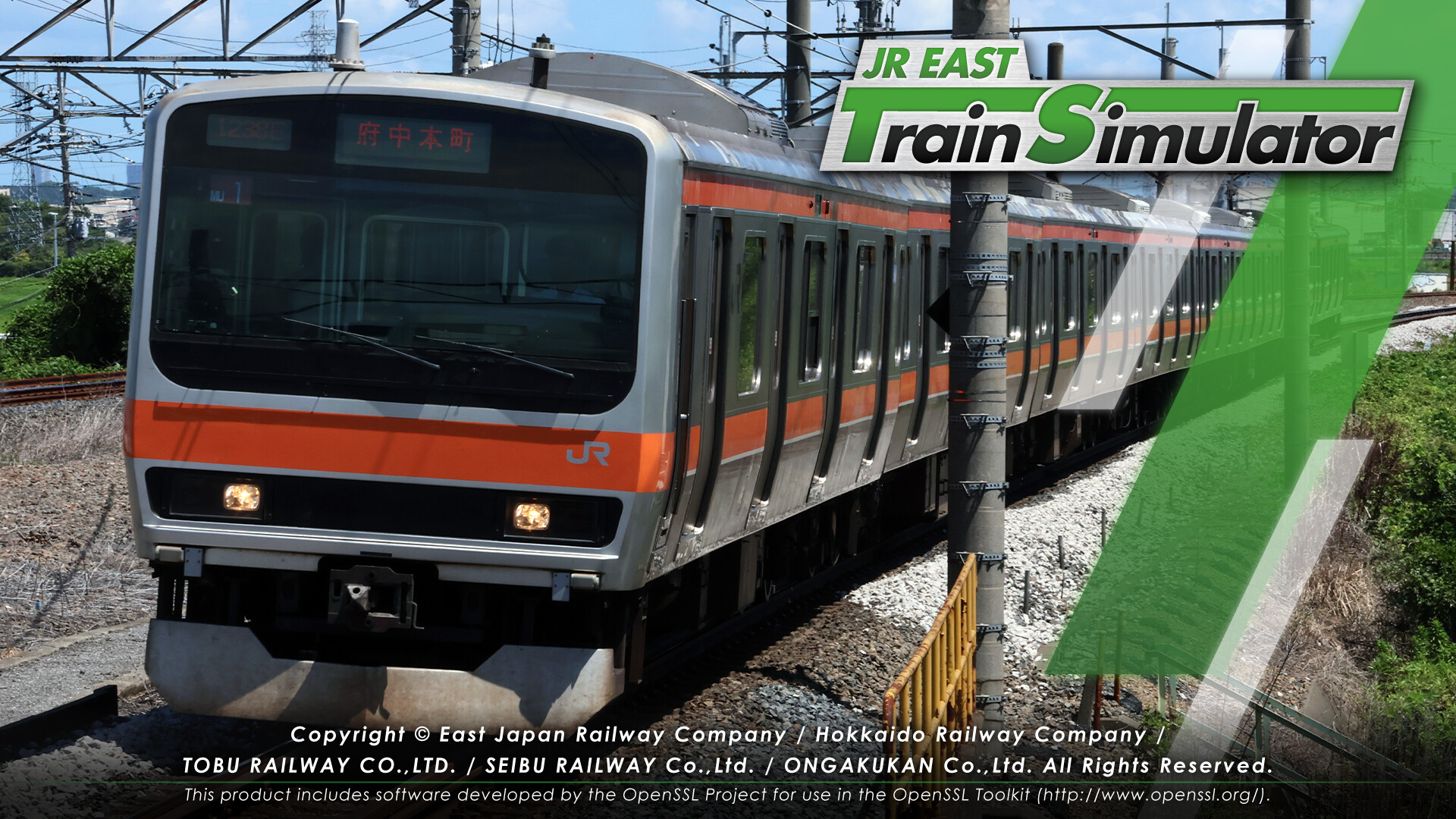
The Musashino Line blends urban and natural scenery, with views of Mt. Fuji, seasonal landscapes, and freight trains. Its tunnels, gradients, and varied terrain make it rewarding to drive, while offering easy access to many leisure and shopping destinations.
Route Overview
The Musashino Line runs between Nishi-Funabashi Station in Funabashi, Chiba Prefecture, and Fuchūhommachi Station in Fuchū, Tōkyō. Through services also operate from Nishi-Funabashi onto the Keiyō Line, and in this content, you can enjoy driving the E231 Series 0 Subseries from Tōkyō Station and Minami-Funabashi to Fuchūhommachi Station.
Originally built primarily for freight transport, the Musashino Line still retains a distinctly railway-oriented character, with passenger and freight trains sharing the same tracks. Along the route, you can see freight terminals and remnants of the former Musashino Marshalling Yard, allowing you to experience the line’s rich history while enjoying the drive.
After departing Tōkyō Station, the train travels through the long underground section of the Keiyō Line before emerging into daylight, where the urban skyline and open waterfront scenery of Tōkyō Bay come into view. As the route continues onto the Musashino Line, the landscape gradually transitions from dense cityscapes to residential neighborhoods, broad rivers, and the lush greenery of the Musashino area. Much of the line runs on elevated structures, and when crossing major rivers such as the Edogawa and Arakawa, passengers are treated to expansive views stretching far into the distance.
At the same time, the line presents a rewarding driving challenge. Gradients and long tunnels can be found between stations, and many platforms are located on sloped track, requiring precise speed control and braking techniques. Experience the unique operation of the Musashino Line as you travel along this vital cross-metropolitan corridor, where the legacy of its freight railway origins meets a diverse panorama of urban and natural scenery.
Highlights Along the Line
※Please note that the points of interest introduced here are highlights found along the Musashino Line. They may not necessarily be visible or featured within the Musashino Line DLC.
□Tōkyō Station – Shin-Kiba Station
After departing Tōkyō Station, the train runs through the underground section of the Keiyō Line. As the train emerges from the long tunnel and reaches the surface, you can enjoy the dramatic transition from the underground section to the open elevated railway.
□Around Shin-Kiba Station
From the elevated tracks, you can enjoy views of central Tokyo’s skyline. Take in the unique scenery of the urban area and the expansive view from the train window.
□Around Kasai-Rinkai Park Station
The Ferris wheel at Kasai Rinkai Park can be seen along the route, and its beautiful illuminations can be enjoyed at night.
□Around Maihama Station
This area is home to theme parks and a variety of leisure facilities. Depending on the time of day, you may even catch a glimpse of fireworks lighting up the night sky.
□Ichikawa-Shiohama Station – Nishi-Funabashi Station
This section offers open views of the Tokyo Bay waterfront. Be sure to enjoy the wide vistas that are characteristic of an elevated railway.
□Minami-Funabashi Station
Large shopping complexes are located near the station. The area is also known for its nearby racecourse and attracts many visitors.
□Nishi-Funabashi Station
Here, the route transitions from the Keiyo Line to the Musashino Line, and the scenery gradually changes. It is also a major transportation hub where several railway lines intersect.
□Funabashi-Hōten Station
One of the nearest stations to the racecourse, it is especially busy on race days.
□Shin-Matsudo Station – Misato Station
In the early morning and during winter, morning mist may spread across the area, creating a magical atmosphere along the line.
□Yoshikawa-Minami Station
In spring, beautiful cherry blossoms bloom along the route, and illuminated scenery can be enjoyed after dark.
□Koshigaya-Laketown Station
The station area features a large shopping complex, making it a convenient destination for shopping and leisure. Be sure to take in the expansive cityscape visible from the elevated tracks.
□Koshigaya-Laketown Station – Minami-Koshigaya Station
Koshigaya Freight Terminal can be seen stretching out on the right-hand side.
□Minami-Koshigaya Station – Higashi-Kawaguchi Station Several lush parks are located along the route, offering beautiful autumn foliage during the fall season. This section also crosses National Route 4.
□Higashi-Kawaguchi Station – Higashi-Urawa Station
The line passes over the Tohoku Expressway in this section. On clear early mornings, Mt. Fuji may be visible ahead through the cab window.
□Minami-Urawa Station – Kita-Asaka Station This section crosses the Arakawa River while running through urban areas. As the train passes over the wide river, the view opens up dramatically, showcasing one of the Musashino Line’s most impressive vistas.
□Around Niiza Station
The line runs alongside a freight terminal, where numerous tracks, freight containers, and railway facilities used for cargo transport can be seen. It is one of the most iconic scenes of the Musashino Line, where passenger and freight trains share the route.
□Shin-Akitsu Station – Shin-Kodaira Station
This section features a long tunnel. Along the route, various railway vehicles stored at railway facilities can also be seen.
□Around Kita-Fuchū Station
At a factory along the line, preserved historic locomotives and railway vehicles from overseas can be seen.
□FuchūHommachi Station
The terminus of the Musashino Line. A racecourse is located nearby, and the area becomes especially busy with visitors on race days.
Route Information
Section: Musashino Line / Tōkyō & Minami-Funabashi →FuchūHommachi
Route Length: 101.3 km
Number of Stations: 36
Train Protection System: ATS-P
Available Timetables
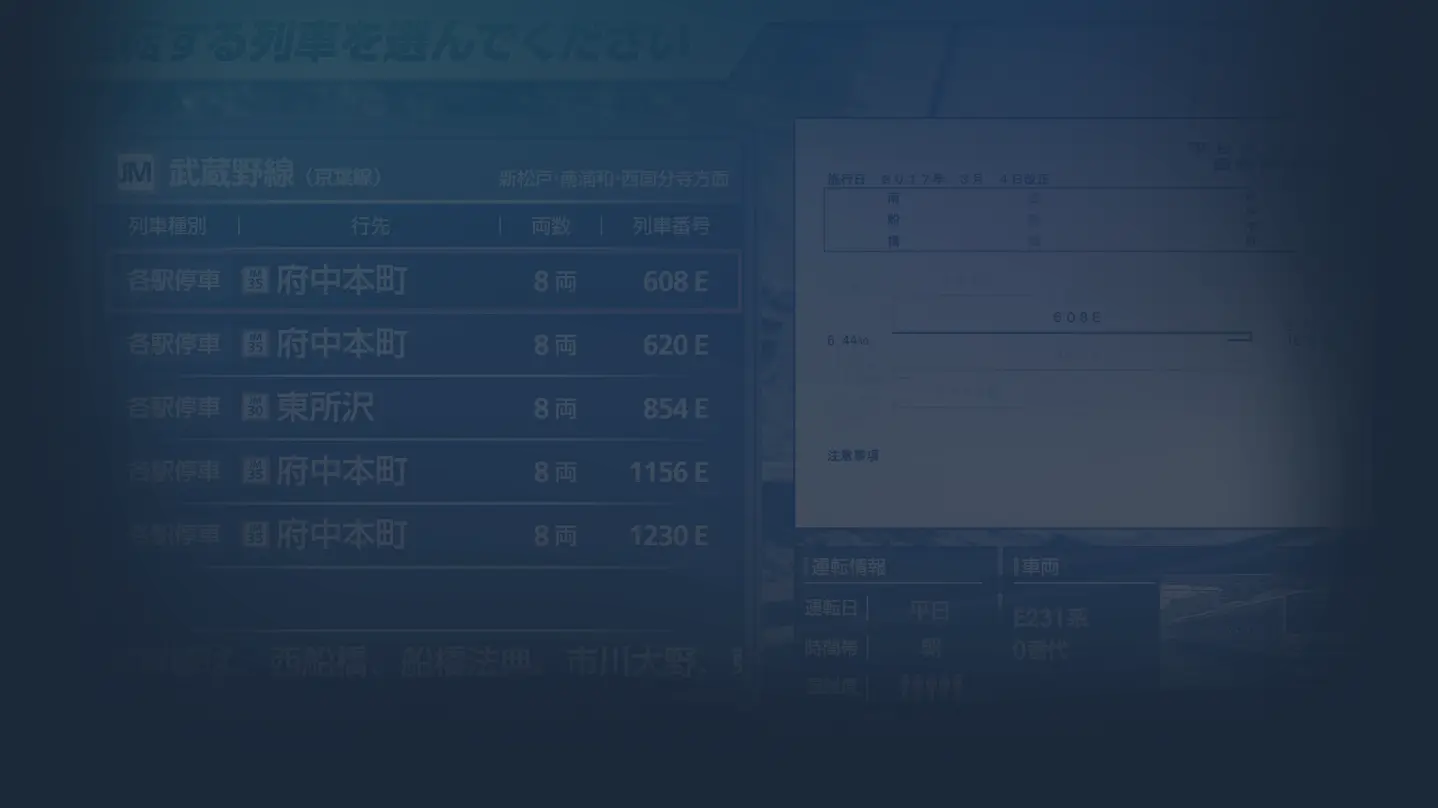
Train Number: Weekday 608E
Service: Local for Fuchuhommachi
Operating Section: Minami-Funabashi (06:44 Departure) → FuchūHommachi (08:15 Arrival)
Rolling Stock: E231 Series 0 Subseries, 8 Cars
In-Cab Announcements: Funabashi Crew Depot
Train Number: Weekday 620E
Service: Local for Fuchuhommachi
Operating Section: Tōkyō (06:26 Departure) → FuchūHommachi (08:19 Arrival)
Rolling Stock: E231 Series 0 Subseries, 8 Cars
In-Cab Announcements: Funabashi Crew Depot
Train Number: Weekday 854E
Service: Local for Higashi-Tokorozawa
Operating Section: Tōkyō (08:39 Departure) → Higashi-Tokorozawa (10:11 Arrival)
Rolling Stock: E231 Series 0 Subseries, 8 Cars
In-Cab Announcements: Funabashi Crew Depot
Train Number: Weekday 1156E
Service: Local for Fuchuhommachi
Operating Section: Minami-Funabashi (11:20 Departure) → FuchūHommachi (12:44 Arrival)
Rolling Stock: E231 Series 0 Subseries, 8 Cars
In-Cab Announcements: Funabashi Crew Depot
Train Number: Weekend & Holiday 1230E
Service: Local for Higashi-Tokorozawa
Operating Section: Tōkyō (12:25 Departure) → Higashi-Tokorozawa (14:13 Arrival)
Rolling Stock: E231 Series 0 Subseries, 8 Cars
In-Cab Announcements: Funabashi Crew Depot
Players who own the 209 Series 500 Subseries DLC can also operate the above timetables using the 209 Series 500 Subseries. No additional timetables are included.
حداقل
- Requires a 64-bit processor and operating system
- OS: 64-bit Windows 11
- Processor: Intel Core i5-8500 or AMD Ryzen 5 2600
- Memory: 16 GB RAM
- Graphics: NVIDIA GeForce GTX 1060(VRAM 6GB)
- DirectX: Version 12
- Storage: 30 GB available space
- Additional Notes: need resolution 1920×1080@60Hz
پیشنهادی
- Requires a 64-bit processor and operating system
- OS: 64-bit Windows 11
- Processor: Intel Core i5 12400 or AMD Ryzen 5 5500
- Memory: 16 GB RAM
- Graphics:
- DirectX: Version 12
- Storage: 30 GB available space
- Additional Notes: Recommended SSD