
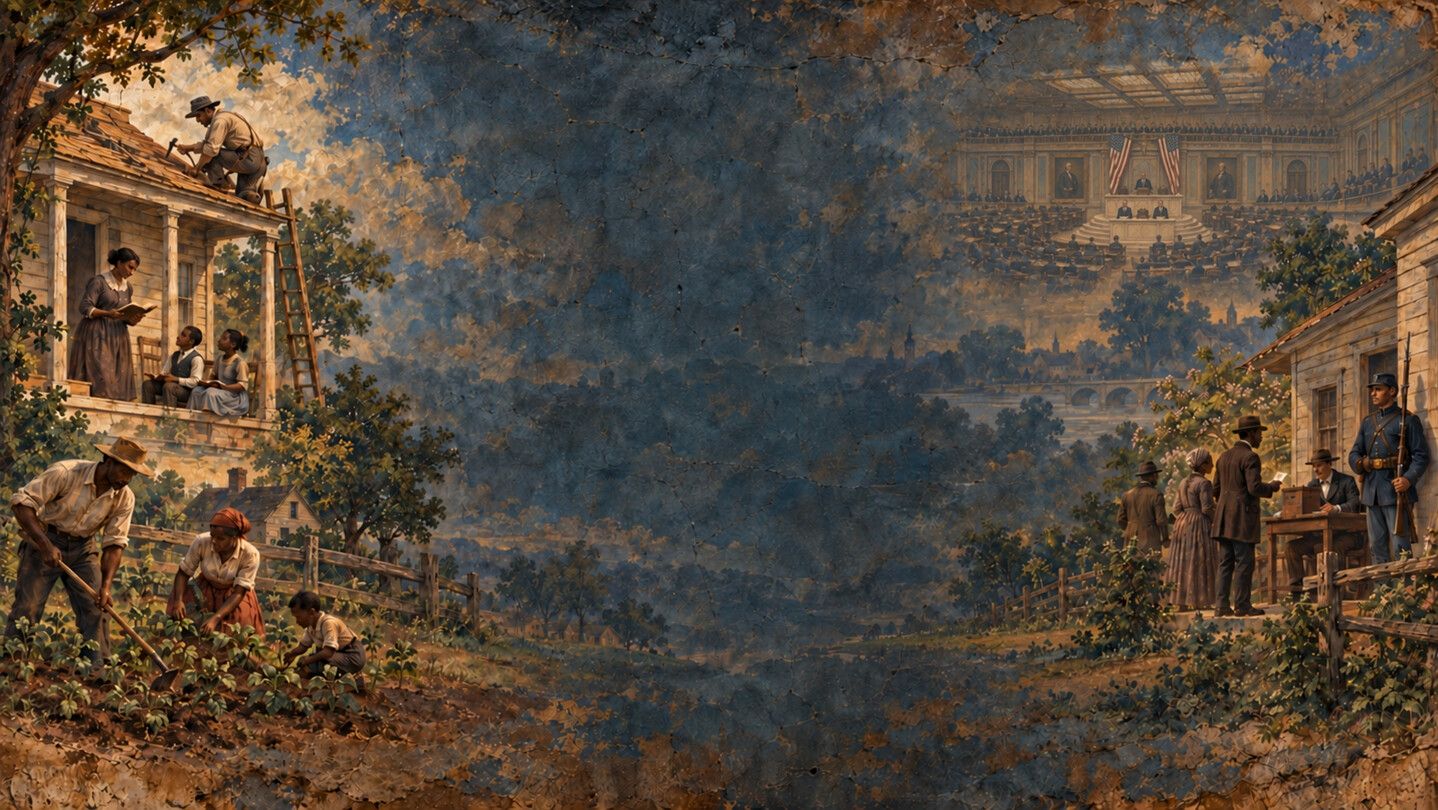
April 1865: Booth's shot misses and Lincoln lives. In this turn-based political strategy game, you count votes in Congress, send troops South and face the Supreme Court, but Lincoln keeps his own mind. In the end, two verdicts: his legend, and what the freedpeople received.
Good Friday, 1865. The shot misses.
Booth is in irons, and Abraham Lincoln is alive. His legend was made by his death: he never had to govern the peace. Here he must. In this turn-based political strategy game, the decisions that fell to Andrew Johnson in real history are yours, for 203 weeks.
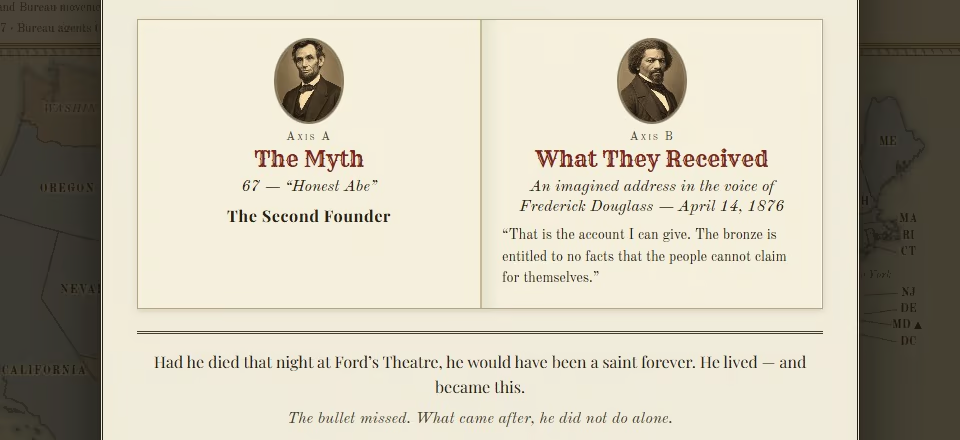
Two verdicts
There is no score. The game ends with two verdicts that need not agree: how America remembered Lincoln, and what his peace meant for the four million people the war set free. A country can love him for the same choices that failed them. The second verdict is an imagined speech by Frederick Douglass.
A President with a mind of his own
You guide Lincoln, but he keeps his own judgment. Bold options stay locked ("Lincoln cannot yet imagine it") until he hears the right people, from Frederick Douglass to William T. Sherman, or reads the right arguments in the partisan press.
The freedpeople do not wait
Whatever you decide, the freedpeople hold conventions, strike, petition Congress and organize to vote. You can widen or narrow what they can do. What they do with it is theirs.
Four years to govern the peace
Congress: count votes bloc by bloc, sign or veto, and risk impeachment.
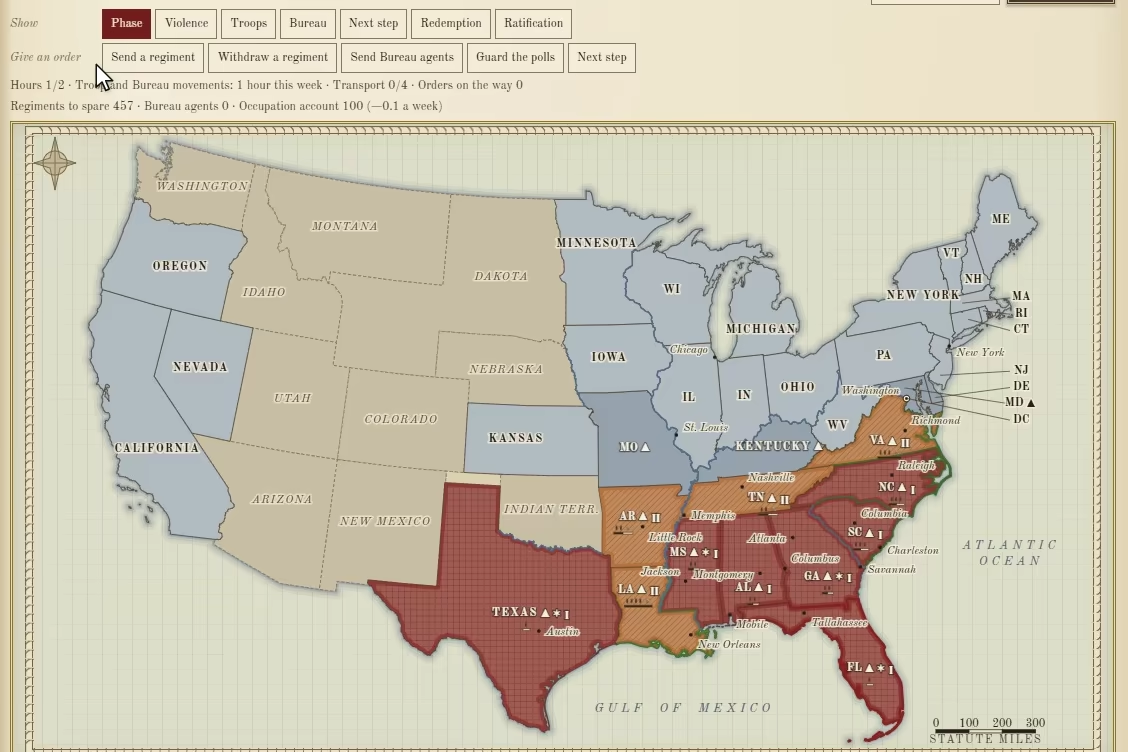
The map of 1865: eleven former Confederate states between occupation and readmission. Pull out the troops and the Freedmen's Bureau, and the reports stop coming.
Elections on their real dates. Given the choices history made, the model reproduces 1868 within three electoral votes.
The Supreme Court: fill its vacancies, or ask a justice for a private word and hope it stays private.
The Myth: spend Lincoln's prestige to persuade, to tip a close vote or, rarely, to act alone.
Roads to the edge
Some roads end with Lincoln removed by the Senate; one ends with a third-term campaign beside Frederick Douglass. None leads back to slavery. Many fail the freedpeople, and the game names those failures.
The game portrays the racism and racial violence of Reconstruction, including the 1866 massacres in Memphis and New Orleans, without gore and without slurs.
"Had he died that night at Ford's Theatre, he would have been a saint forever. He lived — and became this."
حداقل
- OS: Windows 10 64-bit or later
- Processor: Dual-core 64-bit processor, 2.0 GHz
- Memory: 4 MB RAM
- Graphics: Integrated graphics with DirectX 11 support
- DirectX: Version 11
- Storage: 1 GB available space
پیشنهادی
- OS: Windows 10 or 11 (64-bit)
- Processor: Quad-core, 2.5 GHz (Intel Core i3 / AMD Ryzen 3 or better)
- Memory: 8 MB RAM
- Graphics: Any integrated or dedicated GPU with DirectX 11 support
- DirectX: Version 11
- Storage: 1 GB available space