
SpaceSim: Pale Blue Dot
وضعیت
بهزودیقیمت هنوز در استیم اعلام نشده
Build rockets, launch payloads and explore the Solar System in a physics-based space simulation. Unlock parts through launch objectives, develop stations and planetary outposts, then discover orbital mechanics, astronomy and the light-bending gravity of a black hole.
Build rockets. Reach new worlds. Discover the science of space.
SpaceSim: Pale Blue Dot is a single-player space simulation that brings together rocket building, spaceflight and astronomy. Design your own spacecraft, launch useful payloads, explore the Solar System and investigate the gravity of a black hole. Your journey starts with a small test rocket. What you learn and deliver opens the way to larger vehicles, orbital infrastructure and distant destinations.
A modeled spaceport on the Louisiana coast
Your space program has a home at Pelican Point, a coastal launch site modeled in 3D in Vermilion Parish, Louisiana. The setting brings together the High Bay, launch pads and towers, propellant facilities, roads, waterways and Mission Control overlooking the launches. Build in the hangar, send your vehicle to the pad and follow its ascent from the control room or the flight cameras.
The site draws on a conceptual coastal spaceport plan; building details, the control-room interior and its placement are interpretations for the game. You explore a simulated spaceport rather than a surveyed reconstruction of an operating facility.
Design a rocket for the mission
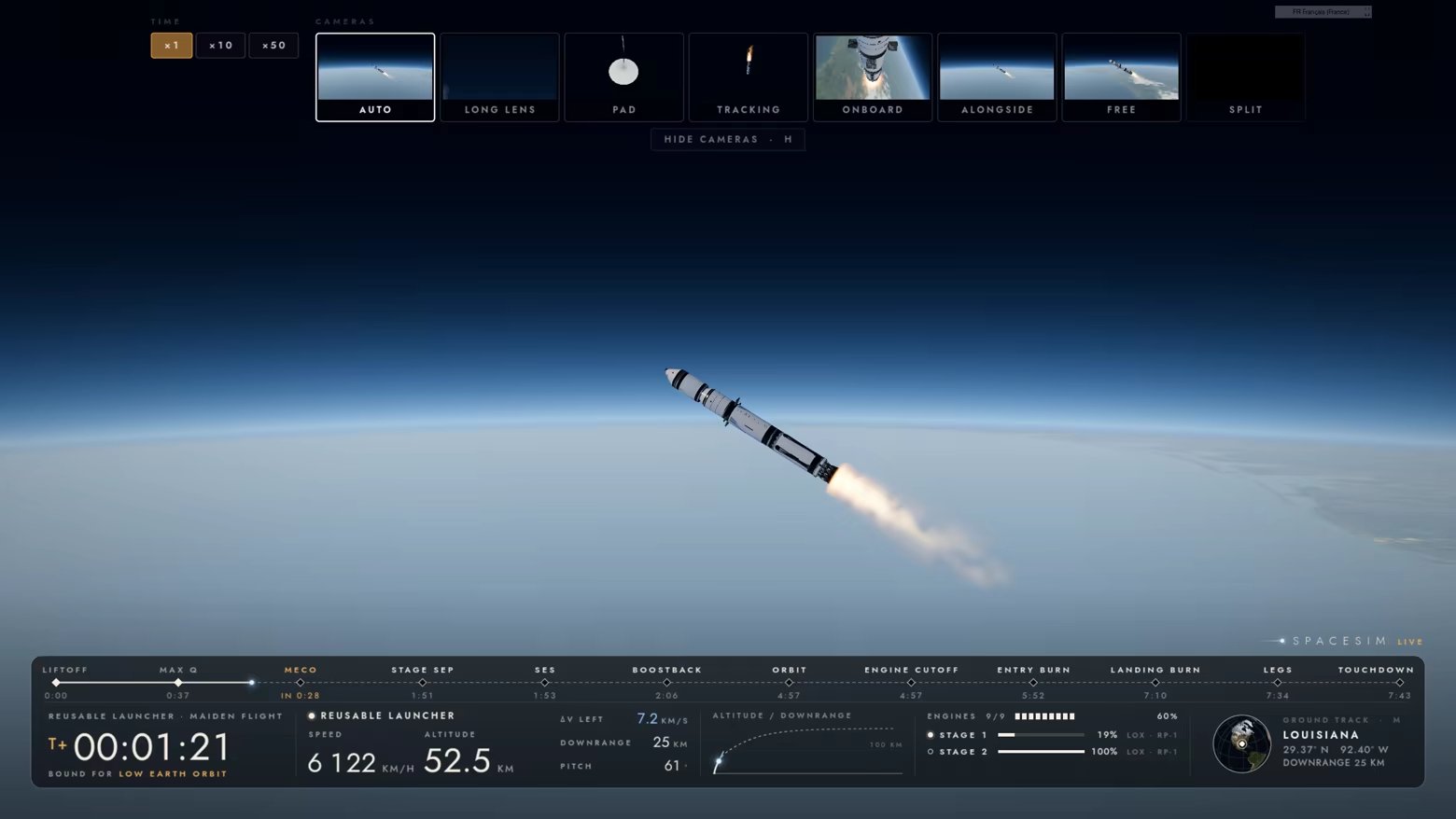
Step into the High Bay at the fictional Pelican Point launch site. Assemble fuel tanks, engines, boosters, decouplers, capsules, landing gear and payload fairings into a vehicle of your own. Compare mass, thrust and delta-v as your design takes shape. A lunar lander, an orbital launcher and a deep-space probe need different solutions: choose the parts, propulsion and cargo that suit the journey.
Read the flight check before committing to launch. It explains what your design can achieve and where it falls short. Refine the rocket, test another combination and turn the figures into a flight you can watch.
Launch, learn and unlock the next step
Follow your rocket from the pad and Mission Control. Reach the edge of space, work toward low Earth orbit, then design for lunar and Martian missions. Successful launch objectives unlock new parts and reference blueprints. You find the solution first; the blueprint becomes a reference after you complete the objective.
The campaign connects the hangar to the destinations. A stronger engine or a larger payload bay has a purpose in the next mission. Study the flight report, return to your design and prepare for the next launch.
Give every payload a purpose
Choose what goes inside your fairing or cargo bay: CubeSats, communications satellites, station modules, habitats, instruments, supplies and rovers. Payload size and mass count toward the vehicle's limits. A load that fits your mission must also fit the rocket carrying it.
Deliver modules for an orbital station, grow a satellite constellation, or send the equipment needed for an outpost on the Moon or Mars. The payload and progression systems track what you deliver and the goals you reach, connecting individual launches to a larger space program.
Explore orbital mechanics above the pale blue dot
Watch Earth's night side turn beneath you and the atmosphere glow at an orbital sunrise. Travel between destinations through the game's missions and journeys, with orbital mechanics and flight readouts giving context to what you see. Guided expeditions provide explanations; free flight lets you take your time and inspect the view.
From Earthrise to the outer planets
See Earth rise over the Moon's horizon and follow the campaign toward lunar and Mars landings. Each destination asks for a design that can reach it: enough delta-v, suitable landing equipment where required, and a payload suited to the place.
Continue to Jupiter and its Galilean moons, Saturn and its rings, and the journey beyond Neptune. Astronomy becomes something you can explore from a spacecraft: compare worlds, follow an expedition and linger beside a planetary horizon. Later chapters introduce speculative propulsion for the journey toward the nearest stars; these systems are identified as speculation within the game's science framework.
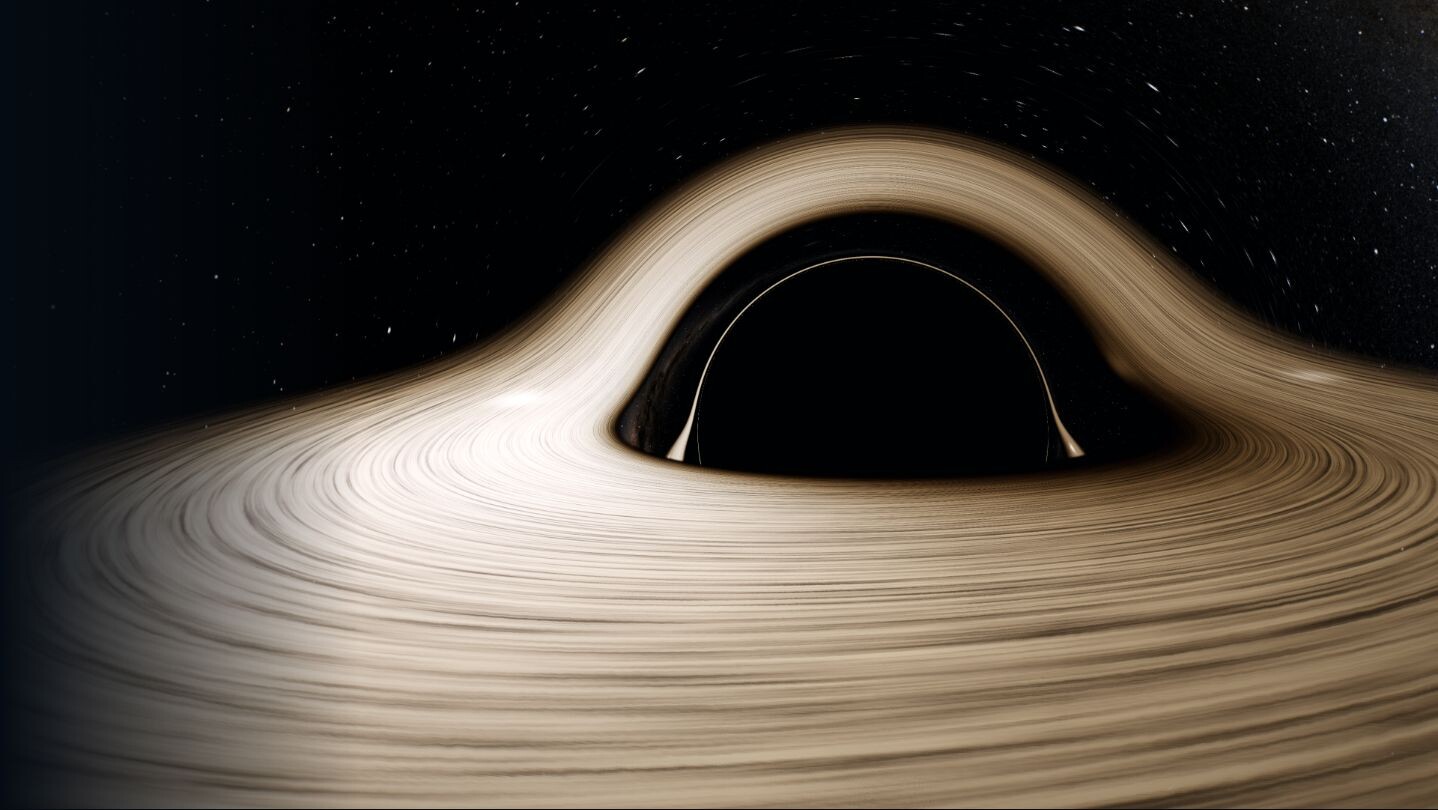
Investigate a black hole, ray by ray
Fly around a non-spinning black hole modeled with Schwarzschild gravity. Examine its shadow and accretion disk, follow the path of light and compare your clock with one far away. Switch light bending, gravitational shift and Doppler beaming on and off to see what each effect contributes.
Try a circular orbit, cut the engine and follow an infalling observer across the horizon. This part of the simulation turns relativity into an interactive experiment, with readouts and ray paths that help explain the changing view.
A space simulation with its assumptions visible
Planetary maps draw on NASA and USGS data. Computed physics, catalogue data, illustrative parameters and procedural detail have different roles, and the game keeps those distinctions visible. Orbital phases and presentation choices are not observations. Pelican Point is an imagined launch site, and its launches are simulated. The black hole model is non-spinning; later speculative engines do not represent technology available today.
Your journey at a glance
Build custom rockets and spacecraft from modular parts.
Check thrust, mass, delta-v and payload fit before launch.
Progress through launch objectives that unlock parts and blueprints.
Deliver satellites, station modules, habitats, supplies and rovers.
Explore Earth orbit, the Moon, Mars and the outer planets.
Follow guided astronomy expeditions or spend time in free flight.
Experiment with black hole gravity, light bending and clock rates.
Play on desktop with keyboard and mouse.
Add SpaceSim: Pale Blue Dot to your wishlist and prepare for your next launch.
حداقل
- OS: Windows 10 / 11 (64-bit)
- Processor: Intel Core i5-8400 / AMD Ryzen 5 2600 (provisional)
- Memory: 16 GB RAM
- Graphics: NVIDIA GeForce RTX 2060, 6 GB VRAM, Vulkan support (provisional)
- Storage: 4 GB available space
- VR Support: No VR headset required. PC VR support is in development and has not yet been validated.
- Additional Notes: Provisional desktop requirements for 1080p at reduced graphics settings, to be refined during Steam Playtest. Keyboard and mouse required.