
Selbstversorger
وضعیت
بهزودیقیمت هنوز در استیم اعلام نشده
An old mountain farm in Upper Carinthia, a few people from the city and five years to learn from the neighbors how to live off it. A narrative game with real weather, a village full of people and decisions that come back next winter.
A farm nobody wanted anymore
Two, three or four of you come from the city and buy an old farm in Upper Carinthia, in the Austrian Alps. The roof holds, the barn stands, the soil is good. What's missing is everything people used to know. Down the road lives Hias. He's old, he has time, and he finds you funny.Learning before it counts
For now the co-op store is full and the bank account is fine. If you like, you can buy the hay you didn't make. But every month there's a new notice on the board at the store, and in the village people talk more quietly than they used to. What you learn in these five years, what you build and who you get on with will count later.The year on the farm
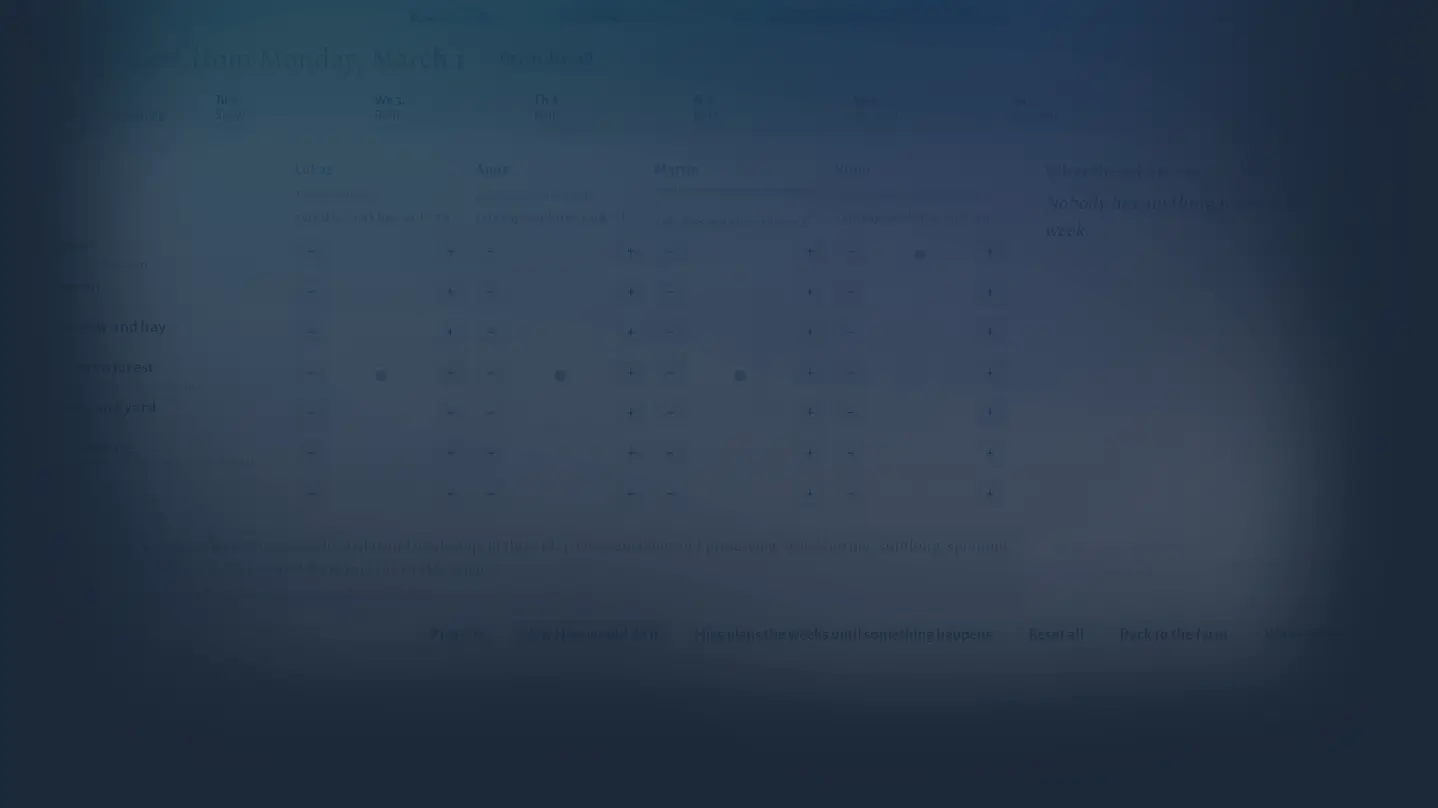
- Plan the week — who goes to the fields, who to the forest, who stays in the parlor. Or "How Hias would do it", and only step in when something's on fire.
- Read the weather — real daily weather data from Carinthia. On haymaking days you decide by the signs in the sky whether to mow. If it rains on the cut grass, the hay is ruined.
- Build what lasts — henhouse, bee house, earth cellar, bread oven, smokehouse: 24 projects, each visible in the farm picture once it's finished.
- Cellar and winter — preserve, dry, pickle or sell. Whether it lasts until Candlemas or until Easter, nobody tells you in advance.
A village with a life of its own
Mass on Sunday and then a beer at the inn, where the regulars' table settles who helps whom with the mowing. Raising the maypole, the church fair, the singers' masked ball, bringing the cattle down from the alpine pasture. The neighbors grow older, marry, have children and die. Whoever belongs gets help. Whoever only buys stays "the ones from up the hill".A crossroads every year
The neighborhood or the farmers' market, bees or cheese, the stranger at the Graben or the wall with the old farmer. There's time for one path, and the other is closed for good. You don't decide with a button but with the hours you put in.Why did that happen?
Every loss tells you its cause: how many wet days, how many frosty nights, how much hay was missing. No hidden dice rolls, no walls of numbers. Behind every rule there's a calculation, and behind every calculation what the old people knew. What the neighbors teach you ends up in your notebook — 98 chapters on old crafts, plants and farm work.Early Access: the first five years
Years 1 to 5 are finished and playable, with their own ending: about seven to ten hours. From year 6 on, what you could buy so far starts to crumble away. That's being worked on.Good to know
- English and German. Names, places and festivals stay Carinthian and are explained when they first appear.
- Three difficulty levels. On "Easy" you can enjoy the village and the story; on "Hard" you can starve.
- A calm path for anyone who finds the calendar too much: Hias plans the weeks until something happens.
- Painted pictures for every season, old Ländler recordings from 1908 to 1917 and the sounds of the farm.
نیازمندیهای سیستم
حداقل
Minimum:
- Requires a 64-bit processor and operating system
- OS: Windows 10, 64-bit
- Processor: Dual core, 2 GHz
- Memory: 4 GB RAM
- Graphics: OpenGL 3 or DirectX 11, 1 GB
- DirectX: Version 11
- Storage: 1 GB available space
- Additional Notes: Screen 1280 x 720 or larger. German only.
پیشنهادی
Recommended:
- Requires a 64-bit processor and operating system
- OS: Windows 10/11, 64-bit
- Processor: Quad core
- Memory: 8 GB RAM
- Graphics: Dedicated graphics card
- DirectX: Version 11
- Storage: 1 GB available space
- Additional Notes: 1920 x 1080